Once the vertical tail’s volume is set, its planform and airfoil decide how it delivers directional stability. Most RC designs use a symmetrical section and a clean planform so the fin and rudder work predictably in both yaw directions.
The Fin Is Shaped to Keep Yaw Under Control
Once the vertical tail has been placed and broadly sized, the question changes.
It is no longer about whether the airplane has enough vertical tail. That was the role of placement and sizing. The next question is how that required area should behave as a fin, and what kind of airfoil section should carry it.
The vertical tail does not follow the same logic as the wing. The wing is shaped around lift, efficiency, stall behavior, and drag. The vertical tail has a different job: it supports directional stability, gives the rudder a stable surface to work from, and helps the airplane resist unwanted yaw.
Planform decides how the required area is distributed: how tall the fin becomes, how deep its chord is, how compact it feels, and how well it supports rudder control.
That is why aspect ratio, taper, and sweep are not styling details. They change how the fin fits, works, and handles structural loads.
The goal is simple: shape the required area so the fin remains effective, structurally credible, and mission-consistent.
Exposure as the First Shape Constraint
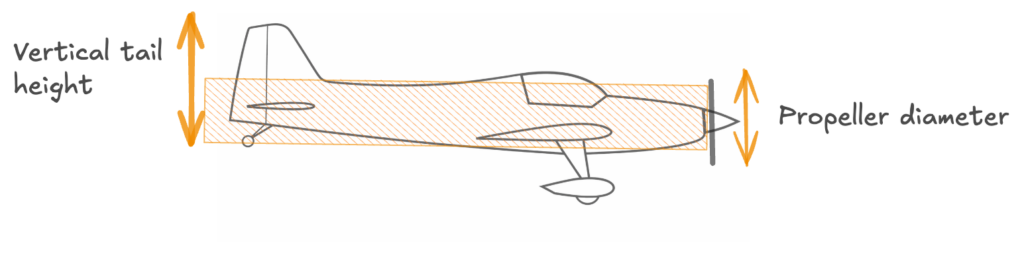
Before refining aspect ratio, taper, sweep, airfoil, or rudder size, the fin must keep enough surface exposed to usable airflow.
Its height and relationship to the horizontal tail decide how much of the fin and rudder remain exposed to usable airflow. That matters most when the airplane is no longer perfectly aligned with the airflow: sideslip, slow flight, stall approach, crosswind correction, or aggressive maneuvering.
The key check is the relationship between the vertical tail and the horizontal tail.
If the rudder sits too deeply inside the disturbed flow behind the horizontal stabilizer, its authority can drop when it is needed most. A taller fin can help, not because height is automatically better, but because it keeps more of the vertical surface in cleaner airflow.
A useful visual check is to look at how much of the rudder remains outside the horizontal tail wake. This wake region is often approximated with two reference lines: one extending aft from the horizontal tail trailing edge at about 30 degrees, and another extending forward from the horizontal tail leading edge at about 60 degrees.
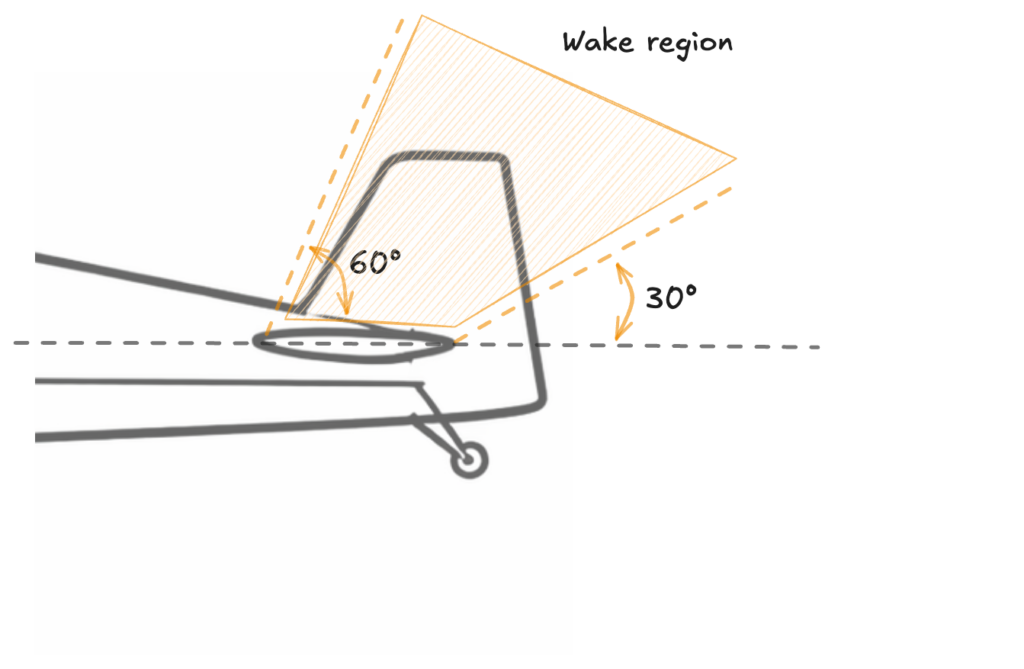
As a practical guideline, at least one third of the rudder should remain outside that wake region. When strong yaw authority or reliable correction at high angle of attack is important, keeping closer to one half exposed is often a safer target.
Propwash can help rudder authority, but the vertical tail should not depend entirely on it. Keep enough fin and rudder exposed to cleaner airflow when the layout allows it.
This is not a strict law. It is a design check.
It forces the layout to respect rudder effectiveness, not just appearance.
So the question is not whether the fin should simply be tall or short.
The question is whether enough of the fin and rudder remain exposed to provide directional stability and usable yaw control.
Once exposure is credible, aspect ratio, taper, and sweep can be treated as refinements.
Aspect Ratio, Taper, and Sweep as Refinements
Once the vertical tail area is broadly defined, the remaining planform choices decide how tall, compact, simple, or refined the fin becomes.
Aspect ratio controls how tall and slender the fin is. A taller fin can improve exposure and directional effectiveness, but it also increases height, root bending loads, and structural demand. For most conventional RC airplanes, vertical tail aspect ratio usually stays around 1 to 2. Lower values keep the fin compact. Higher values can improve effectiveness, but they should be justified by the layout.
Taper should usually stay moderate, often around 0.5–0.8 for most designs. A fuller fin is simple, strong, and forgiving. A more tapered fin can look cleaner and reduce tip area, but too much taper can make the surface sharper without improving the qualities that matter most: directional stability, rudder support, and structural simplicity.
Sweep is also secondary. When used, it usually sits around 35°–45°. On most conventional RC airplanes, vertical tail sweep is often chosen for layout and visual consistency rather than pure performance. Matching or slightly exceeding the wing sweep can be a clean starting point, but the sweep should serve the airplane, not become a styling exercise on its own.
The goal is not to make the fin as tall, swept, or sharp as possible.
The goal is to keep it effective enough to stabilize yaw, but moderate enough to avoid unnecessary height, drag, and structural demand.
These ranges are starting points, not rules.
A trainer usually benefits from a clear, forgiving fin with enough area and exposure to support directional stability. A sport airplane can accept a slightly sharper geometry if it remains predictable. An acrobatic airplane may use a more compact or stylized fin, but it still needs enough exposed vertical surface to preserve rudder authority.
Planform refines the required area. It does not replace it.
Airfoil Choice as a Neutrality Decision
The same neutrality logic applies to the vertical tail.
The fin should not prefer one side. It should stay neutral until sideslip or rudder input asks it to work.
That is why symmetrical or near-symmetrical sections are the safest default. Simple biconvex profiles or NACA 0009 / NACA 0012 sections are usually enough.
Default choice: symmetrical, simple, neutral.
What Planform and Airfoil Choice Set, and What Remains Open
Choosing the vertical tail planform does not change the required vertical tail area. It works inside that requirement.
The previous page established whether the vertical tail had enough exposure, area, and lever arm. This page decides how that area is distributed, how tall or compact the fin becomes, and how neutral the surface remains aerodynamically.
At this stage, the vertical tail has a position, a sizing logic, a planform, and an airfoil direction.
But the tail is still a fixed stabilizing surface.
The next question is how much of that surface should move.
That is the role of the rudder.
RC Plane Designer evolves as chapters are refined and connected.
The project began as a personal notebook used while designing scratch-built RC airplanes.
If you are learning from it or building with it, your feedback helps shape what comes next.
Follow the project or get in touch.