Fuselage length and layout decide how the airplane’s mass, side area, wing, tail, battery, and powertrain are arranged around the center of gravity. Get the proportion right and the tail has enough leverage to stabilize the airplane while the nose carries the powertrain — without forcing a nose-heavy or tail-heavy fix after the fact.
How the airplane occupies space and presents itself
Designing a fuselage is not just drawing a body around components. Once the wing is defined, the airplane already knows how it will generate lift. What remains is to decide how the rest of the airplane extends forward and rearward around that decision.
Before the tail and front lever arms are measured precisely, the airplane already has a proportion, a stance, and a distribution of side area. These choices shape how it works and how it presents itself in flight.
Layout before measured distances
At this stage, the goal is not to define exact geometry. It is to establish how the airplane is distributed around the center of gravity.
The fuselage defines that distribution. It sets how far the airplane extends forward and rearward, how its mass is arranged, and how its overall shape occupies space.
Measured distances will refine this layout later. They do not replace it.
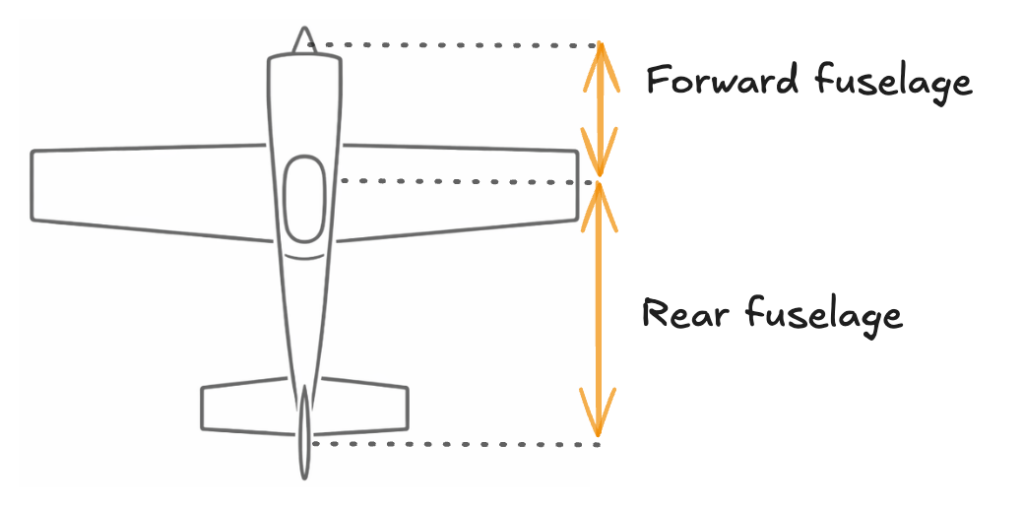
Fuselage proportion around the center of gravity
The wing sits close to the center of gravity because it carries the airplane’s weight. From that point, the fuselage extends forward to support propulsion and onboard equipment, and rearward to support the tail.
Most airplanes extend farther behind the CG than in front of it. A useful starting point is to place roughly one third of the fuselage ahead of the CG and two thirds behind it.
In practical terms, the forward section often measures about 40 to 50 percent of the rear section. These are not targets, only starting points. They are starting proportions that provide enough space for propulsion and equipment while leaving sufficient rearward extension for the tail. This proportion already anticipates the lever arm relationship that will be defined later.
The goal is simple: establish a coherent proportion.
Proportion as character
Fuselage length is not only a matter of packaging. It gives the airplane part of its character.
A longer fuselage suggests steadiness, reach, and a calmer presence in flight. A shorter fuselage suggests a tighter, more immediate, and more aggressive airplane.
These impressions are not only visual. They reflect real tendencies in the design. A stretched layout supports smoother behavior and clearer spacing between components. A compact layout produces a more concentrated and reactive feel.
Proportion sets direction. It does not set the outcome.
Surface distribution
Length alone does not define the fuselage. The distribution of lateral surface area also influences behavior.
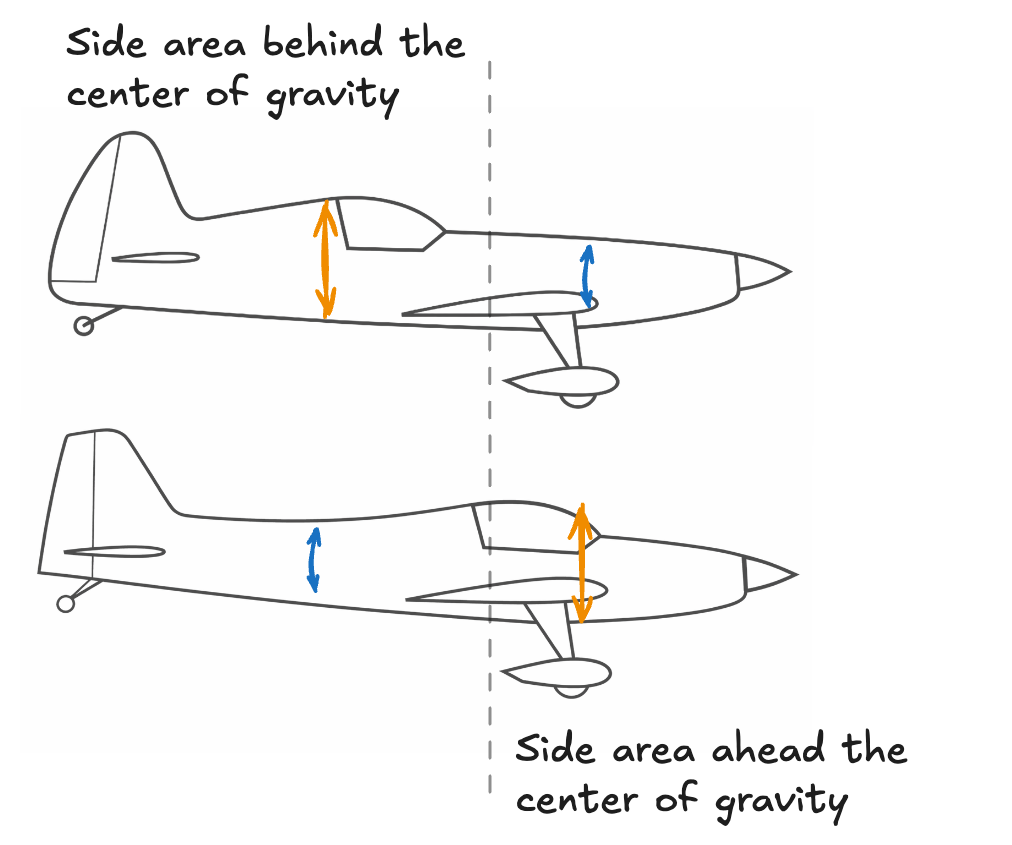
Side area located behind the center of gravity supports directional steadiness and helps the airplane maintain its heading in disturbed airflow or crosswinds. For that reason, many airplanes place more fuselage side area behind the CG than ahead of it.
Too much side area ahead of the CG can work against that balance and make the airplane feel less settled in yaw. That does not mean minimizing the forward fuselage. A moderate amount of side area ahead of the CG can still be useful, especially on aerobatic airplanes where the fuselage contributes to side force.
The goal is not maximizing rear area, but maintaining lateral balance. Side area distribution determines tracking, yaw steadiness, and lateral character.
Flight attitude and visual balance
The fuselage also shapes how the airplane presents itself in flight.
Once wing incidence is defined, the fuselage can be drawn around the reference axis to create a specific flight attitude. Many airplanes appear slightly tail-high in normal flight, which feels natural and balanced. Others sit closer to the airflow and appear more tail-low, which suggests speed and a more aggressive posture.
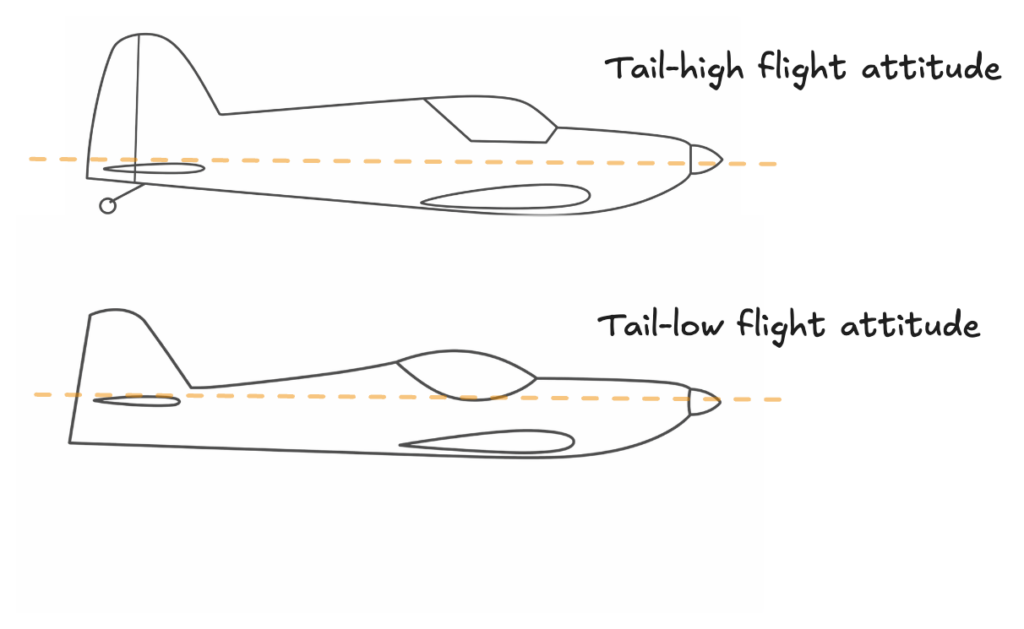
This is not only visual. It determines drag posture, perceived character, and how the airplane carries itself through the air.
Fuselage layout is both functional and expressive.
What layout sets, and what remains open
By the end of this page, overall proportion, side area distribution, and flight attitude are established.
These choices define how the airplane occupies space and how its main components are arranged around the center of gravity.
What remains open are the measured distances that make this layout functional. Tail lever arm and front lever arm will determine how effectively the tail stabilizes the airplane and how easily the airplane can reach the correct balance.
Layout sets the structure. Measured leverage makes it work.
From overall layout to measured leverage
The airplane now has a proportion, a distribution of side area, and a visible flight attitude.
What comes next is not more silhouette work, but measured distance.
The next section turns to the tail lever arm, the distance that determines how effectively the tail can stabilize the airplane. After that, the front lever arm will define how easily the airplane can reach the correct balance without unnecessary ballast.
Overall layout comes first. Leverage comes next.
RC Plane Designer evolves as chapters are refined and connected.
The project began as a personal notebook used while designing scratch-built RC airplanes.
If you are learning from it or building with it, your feedback helps shape what comes next.
Follow the project or get in touch.