Once the horizontal tail’s volume is set, its planform and airfoil decide how it delivers that stability. Most RC tails use a symmetrical or simple flat section with a clean planform, because the tail’s job is steady control authority and predictable pitch response, not lift efficiency.
The Stabilizer Is Not a Smaller Wing
Once the horizontal tail has been placed and sized, the question changes.
It is no longer about how much tail the airplane needs. It is about how that required area should be shaped, and which airfoil should carry it.
The wing is shaped around lift, efficiency, stall behavior, and drag. The horizontal tail has a different job: it supports pitch stability and gives the elevator a stable surface to work from.
Planform decides how the required area is distributed: how wide the stabilizer becomes, how deep its chord is, how compact it feels, and how well it supports elevator control.
That is why span, aspect ratio, taper, and sweep are not styling details. They change how the stabilizer fits and behaves.
The goal is simple: shape the required area so the stabilizer remains compact, strong, predictable, and mission-consistent.
Span as the Framing Decision
Span is usually the first planform decision because it sets the frame for the whole stabilizer.
The horizontal tail should be wide enough to provide a useful stabilizing surface, but compact enough to avoid dominating the rear of the airplane. As span increases, the tail may look more stable, but it also adds structure, bending load, and drag.
For most conventional RC airplanes, horizontal tail span usually sits around one quarter to one third of the wing span. Trainers can sit closer to the upper end of that range. Faster or more aerobatic airplanes often stay closer to the lower end to keep the tail compact and responsive.
Two practical checks help keep the proportion sensible.
Avoid horizontal tail spans approaching half of the wing span unless the configuration clearly needs it.
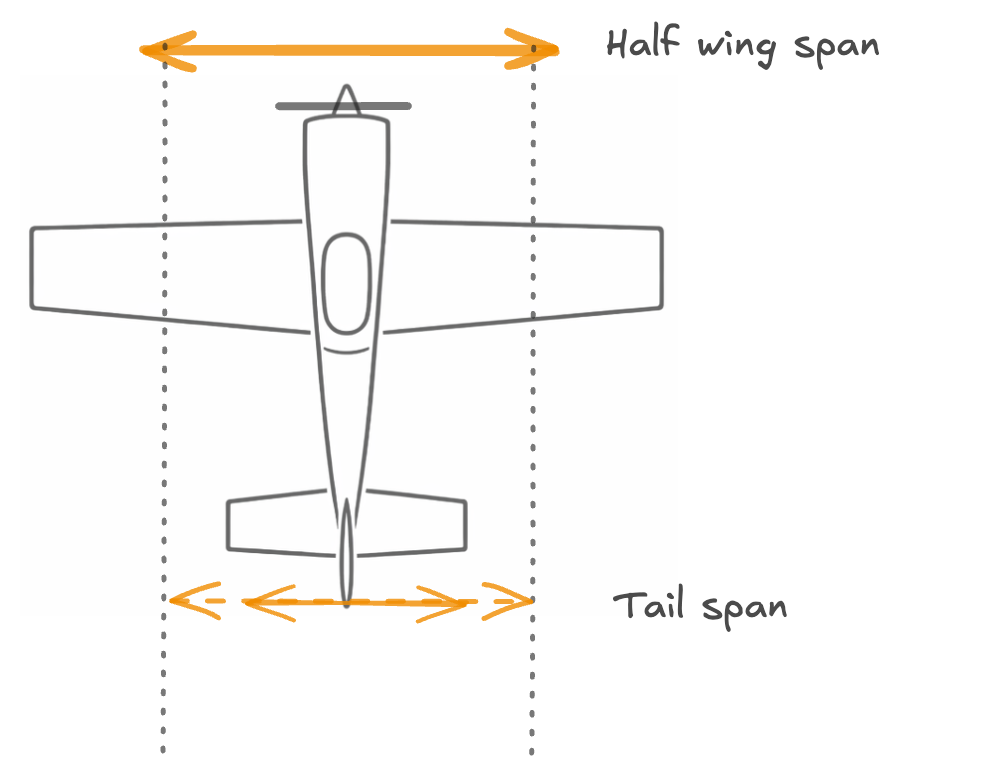
And on single-engine tractor layouts, avoid making the horizontal tail span smaller than the propeller diameter when the layout allows it. Otherwise, too much of the stabilizer may sit inside the strongest part of the propeller slipstream.
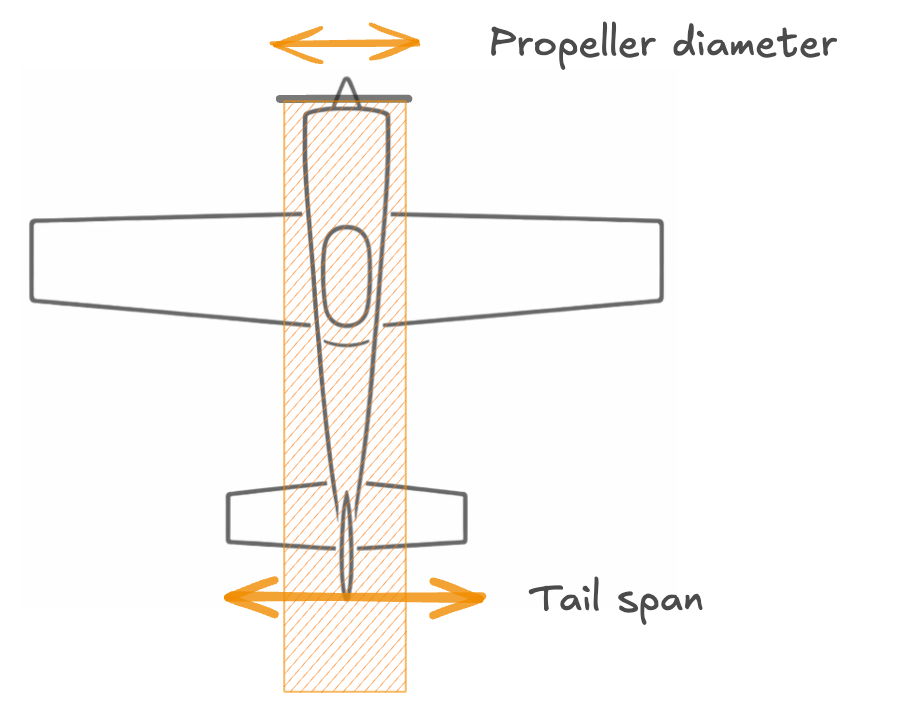
These are not strict rules. They are quick checks before choosing the right mission-consistent range.
Aspect Ratio, Taper, and Sweep as Refinements
Once span sets the frame, the remaining planform choices decide how compact, simple, or refined the stabilizer becomes.
Aspect ratio controls slenderness. Unlike the wing, the horizontal tail is not driven by lifting efficiency first. Lower aspect ratios usually make the stabilizer more compact, easier to build, structurally stronger, and better suited to support the elevator. That is why horizontal tail aspect ratios usually stay well below wing aspect ratios, often around 2 to 5 depending on the mission.
Taper should usually stay moderate. A simple rectangular stabilizer often works perfectly well. It is easy to build, structurally clear, and good enough aerodynamically. Aggressive taper may look lighter or sharper, but it rarely improves the qualities that matter most here: stability, control support, and structural simplicity. Taper ratios below about 0.4 should be used carefully.
Sweep is also secondary. On most conventional RC airplanes, horizontal tail sweep is not a primary performance driver. It is often kept straight for simplicity or matched to the wing for visual consistency. Departing from that can work, but it should serve the layout, mission, or style — not become a styling exercise on its own.
The goal is simple: keep the horizontal tail large enough to stabilize, compact enough to stay practical, and shaped inside the sizing logic already defined. Planform refines the required area. It does not replace it.
Airfoil Choice as a Neutrality Decision
Planform defines how the horizontal tail area is distributed. The airfoil defines how neutral the surface remains.
Unlike the wing, the horizontal tail is not chosen to generate lift efficiently. It should stay quiet until trim or elevator input asks it to work.
That is why symmetrical or near-symmetrical airfoils are the safest default. Sections such as NACA 0009, NACA 0012, NACA 0015, or simple biconvex profiles are common because they behave predictably and avoid adding unnecessary pitching bias.
Cambered sections are usually unnecessary. They can make the tail more trim-sensitive without giving a useful benefit.
Default choice: symmetrical, simple, neutral.
What Planform and Airfoil Choice Set, and What Remains Open
Choosing the horizontal tail planform does not change the required tail volume. It works inside that requirement.
The previous page established whether the horizontal tail had enough area and leverage. This page decides how that area is distributed, how compact or slender the stabilizer becomes, and how neutral the surface remains aerodynamically.
At this stage, the horizontal tail has a position, a sizing logic, a planform, and an airfoil direction.
But the tail is still a fixed stabilizing surface.
The next question is how much of that surface should move.
That is the role of the elevator.
RC Plane Designer evolves as chapters are refined and connected.
The project began as a personal notebook used while designing scratch-built RC airplanes.
If you are learning from it or building with it, your feedback helps shape what comes next.
Follow the project or get in touch.