The fuselage sets the airplane’s proportions and gives every component a coherent place to work from. This section defines its length and layout, then the two lever arms — tail and front — that position the tail, nose, battery, and powertrain around the center of gravity.
Geometric framework of the airplane
Wings make the airplane fly. The fuselage makes the airplane whole.
Once the wing is defined, the airplane already knows how it will generate lift. What remains is to arrange the rest around it. The fuselage turns the wing into a workable airplane by connecting the tail, propulsion system, and onboard equipment into one coherent structure organized around the center of gravity.
The wing defines the flight envelope. The fuselage organizes the airplane around it. The tail uses the distances it creates, and balance confirms whether the arrangement works.
The fuselage does not define flight. It makes it possible.
This section is not about drawing a shape. It is about defining positions, proportions, and distances. The question is not what looks right, but what arrangement allows the airplane to balance correctly, carry its components cleanly, and support the intended flight behavior.
The fuselage as a system of distances
More than anything else, the fuselage creates distance.
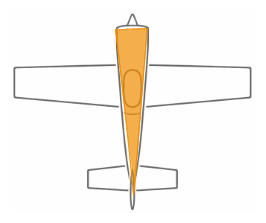
It places the major components along the longitudinal axis. Those positions determine how forces and masses act around the center of gravity. Behind the CG, distance gives the tail the leverage it needs to stabilize the airplane. Ahead of the CG, distance gives the motor, battery, and onboard equipment the leverage needed to balance it.
The fuselage is not just a structure. It is the geometric framework that makes stability and balance possible..
Why this chapter matters
The fuselage does not redefine the mission or replace the decisions already made in the wing. It creates the arrangement that allows those decisions to work together coherently.
It does not decide how the airplane flies. The wing already does.
It makes that flight possible in practice.
It sets the distances that give the tail its leverage and the forward mass its balancing effect. It determines whether the airplane can reach the correct center of gravity without compromise, and whether the overall arrangement remains coherent once all components are in place.
Without a coherent fuselage, a good wing cannot be used effectively.
How this section unfolds
This section follows that logic.
It begins with overall fuselage length and layout, which define how the airplane is distributed around the center of gravity. It then turns to the tail lever arm, which determines how effectively the tail can stabilize the airplane. It then examines the front lever arm, which determines how easily the airplane can reach the correct balance without unnecessary ballast.
Before stabilizing surfaces can be sized with confidence, the airplane first needs the distances that make them effective.
That is where this section begins: not with measurements, but with how the airplane occupies space.
RC Plane Designer evolves as chapters are refined and connected.
The project began as a personal notebook used while designing scratch-built RC airplanes.
If you are learning from it or building with it, your feedback helps shape what comes next.
Follow the project or get in touch.