Wingspan is the wing’s tip-to-tip length, and planform shape — rectangular, tapered, or elliptical — is how its area is outlined. Span is usually set first, bounded by transport, structure, and handling. Rectangular wings are simplest to build and tend to stall gently, while tapered and swept shapes trade some of that forgiveness for cleaner geometry, efficiency, or visual intent.
How wing area is laid out in space
With wing position defined, the next question is how wing area is distributed in space.
Shape and wingspan determine how wing area occupies space around the airplane. That distribution influences stability, roll behavior, and overall efficiency before geometry is defined.
At this stage, the total wing area is not yet fixed.
The goal is to understand how different distributions of a given area influence behavior before committing to dimensions. Shape and span are not cosmetic. They define how lift is arranged in space and how the airplane reacts to disturbances and pilot input.
Distribution comes before precision.
Distribution before numbers
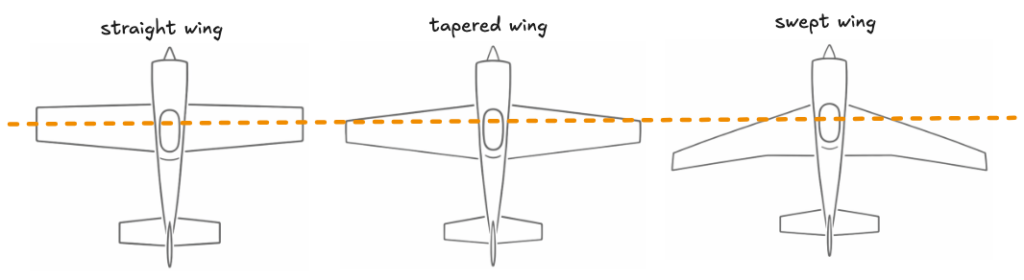
A straight wing spreads its area evenly along the span. Behavior is generally predictable and steady. Stall progression tends to be progressive. Roll response is steady and easy to read. Because the distribution is simple, reactions are easier to anticipate. When consistency matters more than refinement, a straight planform is often the natural starting point.
A tapered wing reduces chord toward the tips. Lift distribution shifts accordingly. Efficiency can improve, and roll response may feel lighter. But stall behavior becomes more sensitive to proportion and twist. Taper is not better. It is more deliberate.
A swept wing changes orientation rather than surface. In full-scale aviation, sweep often answers high-speed demands. In RC design, it is often chosen for visual intent rather than aerodynamic necessity. It can serve specific purposes, but it reshapes low-speed behavior and construction complexity. In this method, sweep is conditional, not default.
Wingspan adds another dimension. Two wings can share the same area yet feel completely different because their spans differ. A longer span spreads lift farther from the centerline, favoring efficiency and steadiness. A shorter span concentrates lift, increases roll authority, and reduces inertia.
Span is not simply “more wing” or “less wing.” It changes how the airplane occupies space, and how quickly the airplane reacts within that space.
At this stage, shape and span express tendencies, not outcomes. They suggest how the airplane may behave, but they do not yet confirm whether that behavior remains coherent with mass and mission.
No surface is fixed. No loading is validated.
Distribution comes first.
Before numbers confirm the wing, distribution defines it.
The next step is to test that intent against reality.
RC Plane Designer evolves as chapters are refined and connected.
The project began as a personal notebook used while designing scratch-built RC airplanes.
If you are learning from it or building with it, your feedback helps shape what comes next.
Follow the project or get in touch.