Wing loading is the airplane’s flying weight divided by its wing area — the first number that shows how hard the wing has to work. Lower loading usually means slower, gentler, more forgiving flight; higher loading usually means faster, more precise, less tolerant flight. It is where the method checks intent against reality.
How much work the wing must actually do
Up to this point, the wing has been defined by intent. Its position sets how lift interacts with the airplane. Its shape and span describe how that lift is distributed in space. But an airplane does not fly on intent alone. The wing must ultimately carry the airplane’s weight.
Surface and wing loading are where intent is checked against reality. They translate ideas about stability, responsiveness, and flight style into a concrete requirement: how much work the wing must perform to keep the airplane flying.
This is the first time the method relies on a number, not to drive the design, but to confirm it. Not to optimize performance, and not to chase precision, but to validate an intention that already exists. A design that feels right on paper must still make sense once mass is taken into account.
The wing does not only generate lift. It carries the entire airplane. Surface alone does not tell you whether that task is reasonable. Weight alone does not either. Wing loading connects them, linking geometry, mass, and flight behavior into a single measurable constraint.
What wing loading changes
A low wing loading favors slow flight, gentle stall behavior, and forgiving handling. The airplane tends to float, land easily, and tolerate imprecise control inputs. The trade-off is increased sensitivity to turbulence and a softer response at higher speeds.
A higher wing loading produces a different character. The airplane feels solid and precise, penetrates the air better, and responds sharply to control inputs. Energy is easier to maintain, but stall speed rises and margins become thinner. The design demands more accuracy from the pilot.
None of these outcomes are inherently better. They simply reflect different intentions. Wing loading makes those intentions visible.
To quantify this choice, the method uses a simple and transparent calculation, expressed in practical units commonly used in RC building. The goal is not to derive a precise number, but to check whether the design remains coherent with its mission.
Wing loading as a practical relation
Wing surface is measured in square decimeters. Dimensions are usually taken in centimeters and converted using the relation 1 dm² = 100 cm².
At this stage, surface is estimated using a simple geometric approximation. It is intentionally practical, not aerodynamic. A more precise reference will be introduced in the next chapter.
The average wing chord is defined as the simple mean of root and tip chords.
Average chord = (Root chord + Tip chord) / 2Wing surface is then obtained by multiplying that average chord by the wingspan. Wing surface can be estimated as:
Wing surface = Average chord × WingspanFinally, wing loading is calculated by dividing the airplane’s weight, expressed in grams, by the wing surface expressed in square decimeters.
Wing loading = Weight (g) / Wing surface (dm²)This number does not predict flight quality. It reveals how demanding the wing is relative to the mass it carries. It allows intentions to be checked before anything is built.
Because this book is mission-driven, wing loading is never interpreted in isolation. Its meaning depends on what the airplane is meant to do.
The ranges below illustrate how wing loading evolves across missions and scale.
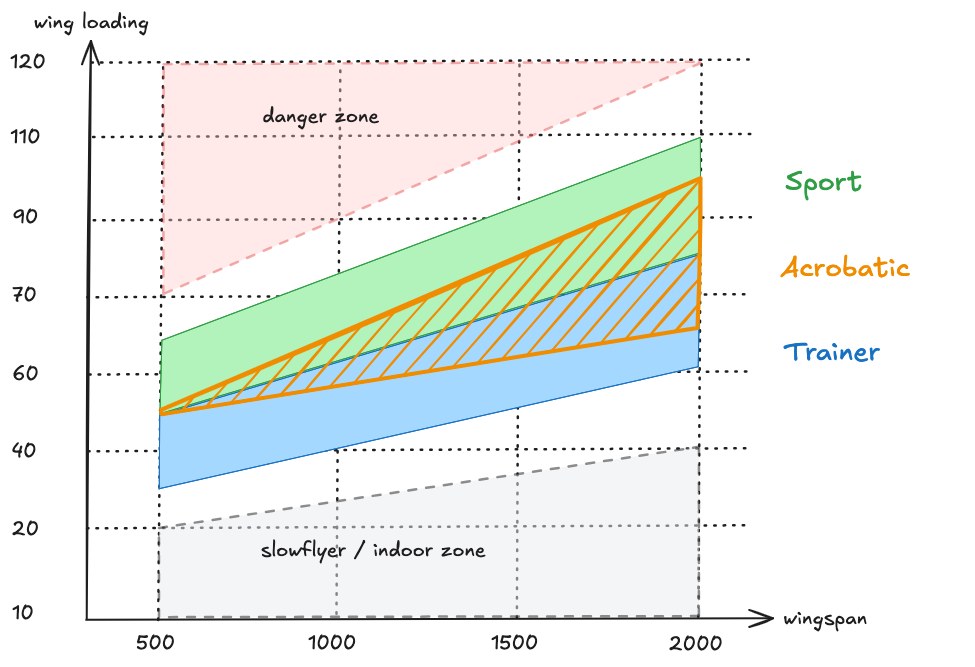
For a trainer, lower wing loading supports stability, slow flight, and confidence-building behavior. For a sport airplane, moderate loading balances responsiveness with accessibility. For an acrobatic design, higher loading favors precision, energy retention, and authority, at the cost of tolerance.
These ranges are not presets. They define mission-consistent ranges. They help determine whether a design remains consistent with its mission before committing further.
If your target weight is not yet clear, start with the Mission Weight Estimator to anchor the design mass.
What wing loading sets, and what remains open
Once wing loading is established, certain characteristics become difficult to change without reworking the design. Stall speed, landing behavior, and overall tolerance are largely defined here. This is why surface and loading are addressed before finer geometric tuning.
At the same time, many decisions remain open. The detailed distribution of area, chord variation, and proportions can still be refined, as long as they remain consistent with the chosen loading.
With wing surface and loading established, the design now needs a stable geometric reference to describe, compare, and adjust the wing consistently.
RC Plane Designer evolves as chapters are refined and connected.
The project began as a personal notebook used while designing scratch-built RC airplanes.
If you are learning from it or building with it, your feedback helps shape what comes next.
Follow the project or get in touch.