The horizontal tail provides pitch stability, and its size is set by tail volume: tail area combined with tail lever arm, measured against the wing. More horizontal tail volume gives stronger, steadier pitch stability. Less volume can make the airplane lighter and more responsive, but also less forgiving.
Giving Pitch Stability Enough Leverage
The horizontal tail does more than complete the rear outline of the airplane.
It is the surface that gives the airplane pitch stability. It is not the airplane’s primary lifting surface. Its job is to create enough correcting force, far enough behind the center of gravity, to keep pitch behavior predictable.
By this point, the fuselage has already created the rear tail lever arm. The horizontal tail now uses that distance. A longer rear fuselage gives the tail more leverage. A shorter one gives it less.
The fuselage did not finish the tail design, but it gave the tail its working distance.
That is why horizontal tail placement and sizing cannot be separated from the fuselage layout.
The first question is not what the stabilizer should look like.
The first question is whether it has enough area, far enough behind the center of gravity, to stabilize the airplane in pitch.
Horizontal Tail Volume as a Geometric Relation
The horizontal tail is not sized like the wing.
The wing is sized as the airplane’s primary lifting surface. The horizontal tail has a narrower job: it must generate enough aerodynamic force, at enough distance from the center of gravity, to stabilize pitch and support elevator control.
That is why horizontal tail size cannot be judged by area alone.
A small tail placed far aft may be effective. A larger tail placed closer to the wing may produce a similar stabilizing effect. What matters is not just how much surface the tail has, but how much leverage that surface has.
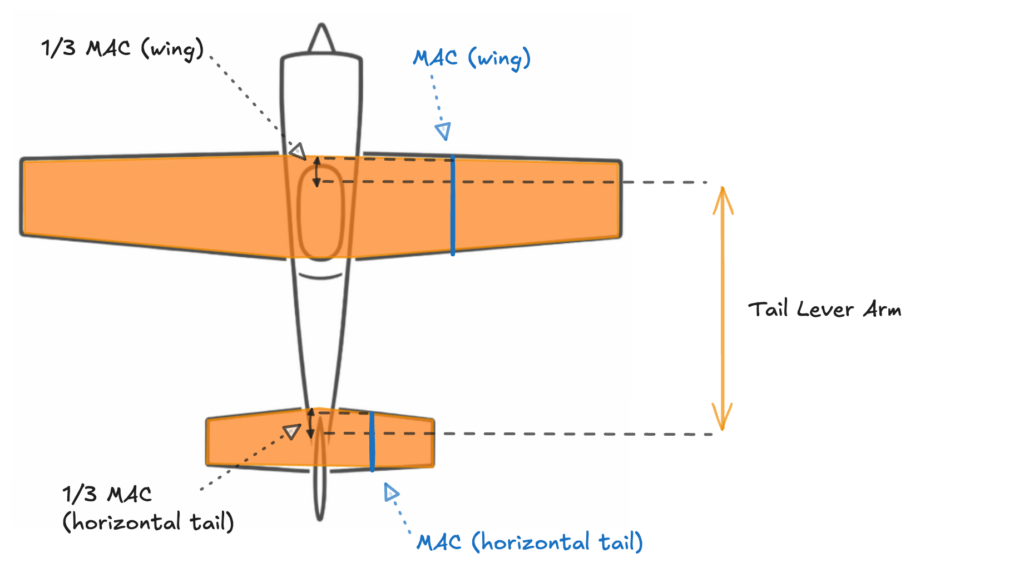
The horizontal tail volume coefficient expresses that relationship.
Horizontal tail volume coefficient =
(Horizontal tail area × Tail lever arm) / (Wing area × Wing MAC)
In preliminary design, horizontal tail area usually refers to the complete horizontal tail: fixed stabilizer plus elevator.
The tail lever arm is the distance that gives the tail its leverage. In practical design, it is usually measured from the expected center of gravity region to the aerodynamic center of the horizontal tail.
The name can be misleading. It is not a volume in the literal sense. It is a dimensionless design ratio. But it is useful because it turns a vague visual question into a structured design question:
Does the horizontal tail have enough area, far enough behind the center of gravity, to stabilize the wing it belongs to?
The formula can also be reversed when a target coefficient is known and the required horizontal tail area must be estimated:
Horizontal tail area =
(Horizontal tail volume coefficient × Wing area × Wing MAC) / Tail lever arm
This makes the coefficient useful while the design is still open.
If the tail lever arm becomes longer, the same stabilizing effect can be achieved with less horizontal tail area. If the tail lever arm becomes shorter, the stabilizer usually needs more area to compensate.
The coefficient is not something to calculate only after the airplane is drawn. It is a practical way to keep the tail, fuselage, and wing in proportion while the design is still being shaped.
Practical Limits and Mission-Consistent Ranges
The horizontal tail volume coefficient does not tell you whether the airplane will feel perfect. It does not replace balance checks, airfoil choice, elevator sizing, or flight testing.
But it strongly influences how much pitch stability and pitch authority the airplane can have.
If the coefficient is too low, the tail has too little leverage for the job. The airplane may feel sensitive in pitch, less forgiving around trim changes, and less stable when speed or attitude changes. In more severe cases, trim authority may become limited and the airplane may feel nervous instead of precise.
If the coefficient is too high, the tail has more influence than necessary. This often makes the airplane easier to settle and more stable in pitch, but it can also make the design feel heavier, more damped, or less responsive than intended. A larger tail also adds surface area, drag, structure, and weight.
The goal is not to maximize the coefficient.
The goal is to place it in a mission-consistent range: enough leverage to stabilize and support control, without making the tail unnecessarily dominant.
Go-to values — Horizontal Tail Volume
| Type | Minimum | Medium | Maximum | Flight insight |
|---|---|---|---|---|
| Trainer | 0.55 | 0.65 | 0.75 | A trainer favors a higher tail volume, giving the horizontal tail extra leverage so pitch stays predictable and forgiving around trim changes. |
| Sport | 0.45 | 0.55 | 0.65 | A sport airplane balances pitch stability and responsiveness, keeping enough tail leverage without making the airplane feel heavy or over-damped in pitch. |
| Acrobatic | 0.40 | 0.50 | 0.60 | An acrobatic design may accept a lower tail volume to keep pitch response immediate, provided elevator sizing and CG placement are handled deliberately. |
These values apply to the complete horizontal tail area: fixed stabilizer plus elevator.
They should be treated as starting ranges, not final guarantees. The final behavior still depends on center of gravity, static margin, elevator sizing, control setup, and flight testing.
What Horizontal Tail Sizing Sets, and What Remains Open
Horizontal tail placement and sizing establish the foundation of pitch stability.
They decide how much leverage the stabilizer has, whether its area is broadly coherent with the wing and fuselage, and whether the tail has enough authority to support pitch stability before the elevator is even considered.
But they do not finish the horizontal tail.
They do not define the exact planform. They do not choose the airfoil. They do not determine elevator size. They do not solve final trim or replace the later balance check.
At this stage, the horizontal tail has a working distance and a sizing logic tied to the airplane around it.
The next question is no longer whether the tail is large enough in principle.
The next question is how that required area should behave as a shape.
Span will frame the surface. Aspect ratio, taper, and sweep will refine how the area is distributed. The airfoil will decide how neutral the stabilizer remains while doing its job.
That is the role of planform and airfoil choice.
RC Plane Designer evolves as chapters are refined and connected.
The project began as a personal notebook used while designing scratch-built RC airplanes.
If you are learning from it or building with it, your feedback helps shape what comes next.
Follow the project or get in touch.