The tail makes the airplane’s behavior predictable. This section sizes and shapes both stabilizing systems — the horizontal tail for pitch and the vertical tail for yaw — then sets the elevator and rudder authority needed to control the airplane without making it sluggish or unstable.
Correcting and Stabilizing the Airplane
The wing makes flight possible. The tail makes it usable.
By the time you reach the tail, the airplane is no longer an empty outline. The wing has already defined how the airplane will generate lift. The fuselage has arranged the main masses, proportions, and lever arms that give the design its usable structure.
What remains is not to add decoration at the rear of the airplane.
What remains is to stabilize the result.
That is the role of the tail.
The tail is not the airplane’s primary lifting surface. It corrects what the rest of the airplane creates. It helps prevent pitch from becoming unstable, heading from wandering, and control from feeling either vague or excessive.
It is the part of the design that quietly turns geometry into behavior.
Without a well-designed tail, an airplane may still produce lift. But it will not necessarily hold attitude cleanly, recover direction reliably, or respond with the level of confidence the pilot expects.
The Tail as a Stabilizing System
The tail is not a single surface. It is a stabilizing system working on two main axes.
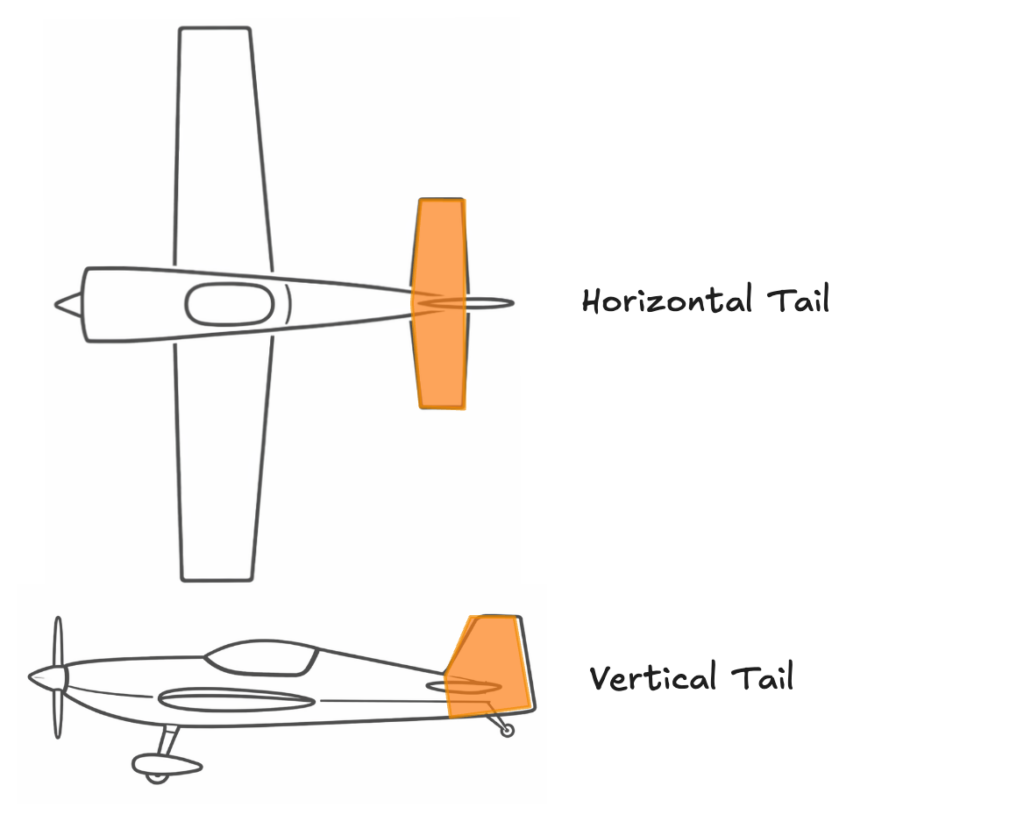
The horizontal tail manages pitch. It helps the airplane remain trimmed, supports longitudinal stability, and gives the elevator a stable base from which to command nose-up and nose-down motion.
The vertical tail manages yaw. It helps the airplane hold its heading, resist unwanted sideslip, and gives the rudder the authority needed to correct direction when the airplane is no longer perfectly coordinated.
These surfaces do not work alone. Their effectiveness depends on the wing they must stabilize, the fuselage distances that give them leverage, and the way their own planform, airfoils, and movable control surfaces are chosen.
In that sense, the tail is not an add-on.
It is the airplane’s stabilizing system.
Stability Before Control
A common mistake is to think about the tail through its control surfaces first: elevator throw, rudder size, maximum authority, or aerobatic response.
But the fixed surfaces come first.
Before the elevator can provide clean pitch control, the horizontal tail must be placed where it can work and sized with enough leverage to stabilize the airplane.
Before the rudder can provide useful yaw control, the vertical tail must be exposed, proportioned, and large enough to support directional stability.
The movable surfaces only work well when the fixed surfaces give them a stable foundation.
A tail that is too small, poorly exposed, or geometrically inconsistent may still look acceptable on paper. In flight, the problems appear differently: pitch that feels nervous, heading that wanders, rudder authority that fades when the airplane slows down, or control surfaces that need too much deflection because the basic proportions were never right.
That is why the tail must be designed first as a stabilizing system, then refined as a control system.
What the Tail Must Set
Some design choices define what an airplane can do. Others determine whether it will do it cleanly.
The wing sets the flight envelope. The fuselage creates the arrangement. The tail corrects and stabilizes the result so the airplane can remain coherent in the air.
Its decisions are usually quieter than those of the wing. But they are no less important. A poor wing is obvious. A poor tail often reveals itself later, through trim problems, weak correction behavior, or control that never feels fully right.
The tail has to answer four practical questions.
Where should the stabilizing surfaces sit?
How much area and leverage do they need?
How should their shape and airfoil refine their behavior?
And how much of each surface should become active control?
Those questions define the sequence of the chapter:
Place the stabilizing surface. Size it. Shape it. Then decide how much of it should move.
The first tail decisions are therefore not about control throws or cosmetic outline. They are about leverage, exposure, and proportion.
Before deciding how much of the tail should move, the stabilizing surfaces themselves must be placed where they can work, and sized so their control surfaces have something solid to build on.
The tail begins with pitch stability: where the horizontal tail sits, and whether it has enough leverage to do its job.
RC Plane Designer evolves as chapters are refined and connected.
The project began as a personal notebook used while designing scratch-built RC airplanes.
If you are learning from it or building with it, your feedback helps shape what comes next.
Follow the project or get in touch.