Wheels don’t fly, but they decide how the flight begins and how it ends.
Landing gear is not a flying surface, but it is still a balance decision. It defines how the airplane balances on the ground.
It decides how the airplane meets the runway, absorbs the first shock of landing, clears the propeller, rotates on takeoff, and avoids tipping during taxi, rollout, or an imperfect touchdown.
That is why it belongs in this chapter. The airplane does not only need to be balanced in the air. It also needs to be balanced while resting on three points on the ground.
For this method, we focus on a conventional taildragger layout: two main wheels carry most of the landing load, while the tailwheel sets the airplane’s ground attitude. Other gear arrangements follow their own geometry, but the core question remains the same: where should the contact points sit so the airplane can roll, rotate, land, and recover from imperfect touchdowns without fighting itself?
Geometry that works
Main gear placement is a compromise between rotation and ground safety.
On a taildragger, the main gear is placed ahead of the center of gravity. If it sits too far forward, the airplane becomes difficult to rotate because the wheels resist the nose rising into flight attitude. If it sits too far back, the airplane becomes more likely to tip onto its nose during landing or braking.
The geometry must also keep the airplane inside a usable ground envelope. The gear must provide enough propeller clearance, enough ground angle for rotation, and enough lateral stance to resist tipping.
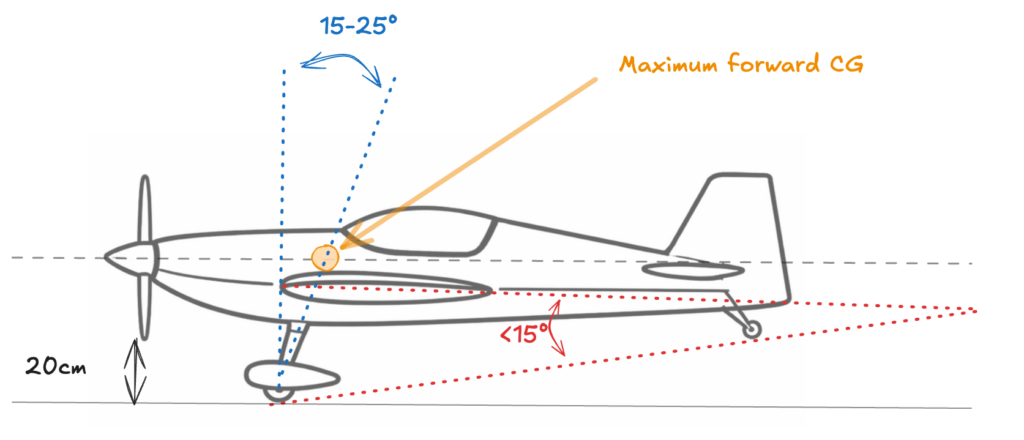
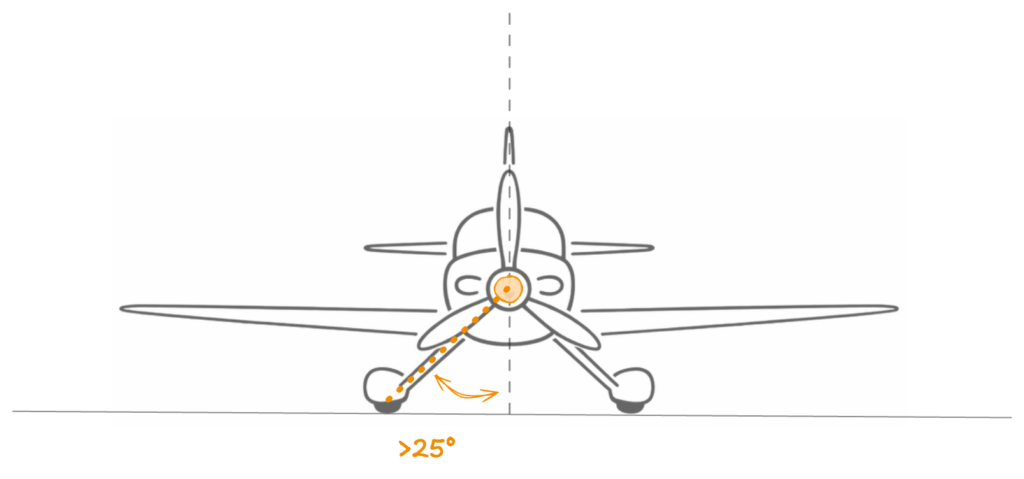
Use these as practical design references:
Main gear placement angle: 15° to 25° forward of the vertical line through the forward CG.
Propeller clearance: keep generous clearance in level attitude, and always preserve positive clearance when the gear is compressed or the tires are soft. For larger conventional models, 20 cm is a useful conservative reference.
Tailwheel ground angle: below about 15°, or roughly 1° to 2° less than the maximum lift angle of attack.
Minimum tip-over angle: at least 25° between the vertical line through the CG and the line from the CG to the main wheel contact point.
These values are not cosmetic. They define whether the airplane can rotate, clear the propeller, keep the right ground attitude, and remain stable on the ground.
Why it matters
A landing gear that looks right on the bench can still fail on the runway.
If the gear is too short, propeller clearance disappears when the airplane lands hard or the tires compress. If the main gear sits in the wrong place, rotation becomes awkward or the airplane becomes prone to nose-over. If the track is too narrow, the airplane becomes vulnerable to tipping during a turn, a crosswind landing, or a bump on the runway.
The tailwheel also has to do more than simply touch the ground. It should sit far enough aft to improve ground leverage, while still being supported by a structure stiff enough to handle taxi and landing loads. The airplane should touch on the main gear first, not arrive tailwheel-first, and it must still keep enough tail clearance during takeoff rotation.
So landing gear has three jobs at once. Longitudinally, it must work with the CG to allow rotation without nose-over risk. Vertically, it must provide propeller clearance and absorb landing loads. Laterally, it must give enough stance to resist tipping.
Good landing gear does not make the airplane fly better in cruise. But it makes the airplane usable. It protects the propeller, the structure, and the pilot’s confidence. Get it wrong, and even a well-balanced airplane may not survive the runway.
With this page, the balance check is complete: the airplane now has aerodynamic references, a mass reference, a stability margin, and a ground stance. The next step is no longer to define isolated parts, but to bring the whole design back through a complete design cycle.
RC Plane Designer evolves as chapters are refined and connected.
The project began as a personal notebook used while designing scratch-built RC airplanes.
If you are learning from it or building with it, your feedback helps shape what comes next.
Follow the project or get in touch.