Where lift acts and how the airplane presents itself
Before the wing has shape, span, or loading, it has a position.
Wing configuration defines where lift acts relative to the fuselage. That early decision influences stability, structure, visibility, and the overall character of the airplane. It comes first because all later decisions must work within that position.
Configuration is often treated as preference or aesthetic choice. It is both functional and expressive. A high-wing trainer and a low-wing acrobatic airplane signal different intent before any numbers are defined.
This page does not rank configurations. Its role is to clarify what each favors, what it sacrifices, and how that first structural choice constrains the design.
Wing configuration as a structural commitment
The wing generates lift, but its position determines how that lift interacts with the fuselage and tail.
Configuration sets the initial balance between stability and responsiveness. It establishes structural layout, visibility, and the way mass and moments will later be managed.
Once chosen, configuration does not define geometry or loading. But it conditions them; it determines which solutions remain viable.
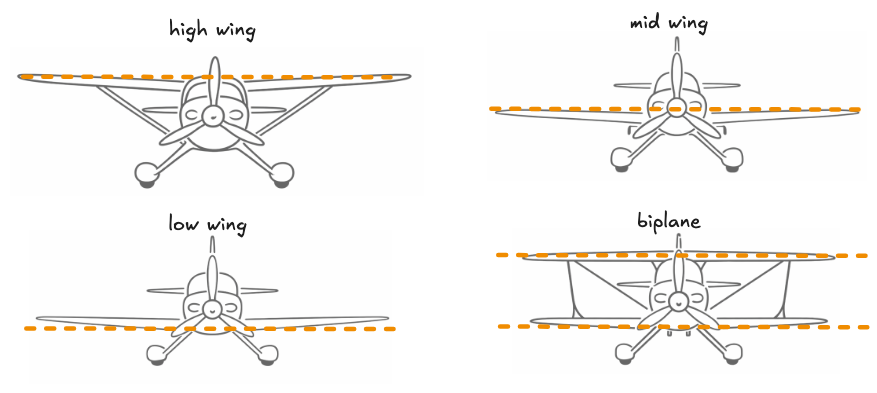
A high-wing configuration places lift above the fuselage. It favors stability and forgiving behavior. It supports slow flight and predictable behavior, making it a natural choice for Trainer missions. The trade-off is softer roll response and less immediate control feel. It favors accessibility over precision in control feel.
A low-wing configuration places lift below the fuselage. It emphasizes control and responsiveness over passive stability. Roll response is typically sharper, and the airplane feels more directly connected to pilot input. It aligns naturally with Sport and Acrobatic missions, at the cost of reduced forgiveness.
A mid-wing configuration aligns lift near the fuselage centerline. It offers clean aerodynamic symmetry but increases structural and practical complexity. It is rarely chosen by default. It is chosen deliberately when balance and precision outweigh ease of construction.
Biplanes are acknowledged as both configuration and stylistic statement. They introduce additional aerodynamic interaction and structural reasoning. For that reason, they are treated separately within the method.
Choosing a wing configuration does not define the airplane; it defines the context.
Once lift position is fixed, the design moves from where lift acts to how lift is distributed in space.
RC Plane Designer evolves as chapters are refined and connected.
The project began as a personal notebook used while designing scratch-built RC airplanes.
If you are learning from it or building with it, your feedback helps shape what comes next.
Follow the project or get in touch.