How wing chord is distributed along the span
Span is set. Wing area is fixed. Wing loading is coherent.
What remains open is how chord varies from root to tip. Taper ratio defines that variation.
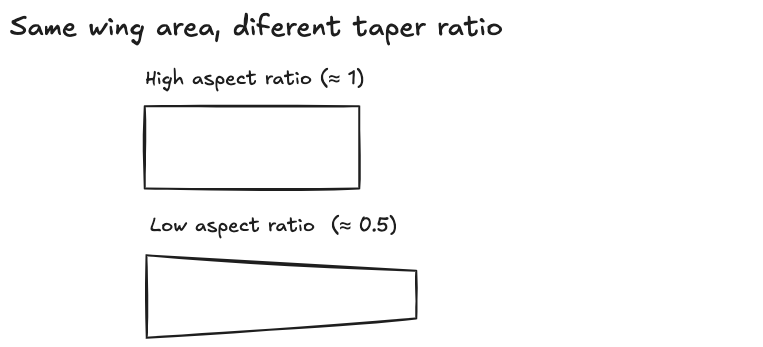
Two wings can share the same area, span, and loading, yet behave differently because their chord distribution is different.
What taper ratio really changes
Taper ratio influences how lift builds and how stall progresses.
A low taper ratio, meaning a narrow tip compared to the root, reduces chord toward the wingtip. This shifts lift distribution inward and can help reduce tip stall sensitivity if proportions are chosen carefully. The wing may feel more predictable near the limit, but structural loads concentrate closer to the root.
A taper ratio close to 1.0 approaches a rectangular wing. Lift distribution becomes more uniform. Construction is simpler, and stall behavior is typically more progressive, especially for trainer-type designs.
As taper becomes more aggressive, the wingtip becomes narrow relative to the root. Roll inertia may decrease slightly because less mass sits near the tip, but tip stall sensitivity increases if not compensated by twist, airfoil choice, or other design measures.
Taper interacts with aspect ratio, wing loading, and mission intent.
Taper ratio as a geometric relation
Taper ratio is the ratio between tip chord and root chord.
Taper ratio (λ) = Tip chord / Root chordA rectangular wing has a taper ratio of 1.0.
Values lower than 1.0 indicate taper.
Wing surface remains constant. Changing taper requires adjusting root and tip chord while maintaining total area.
When span and surface are fixed, decreasing taper ratio typically requires increasing root chord while reducing tip chord. The mean aerodynamic chord adjusts accordingly, which is why the MAC was defined earlier.
Taper ratio does not dictate performance. It describes how geometry expresses earlier design decisions.
Designing inside mission-consistent ranges
Like aspect ratio, taper ratio operates inside mission-dependent ranges.
It is selected to support predictable stall behavior, manageable structure, and coherent lift distribution.
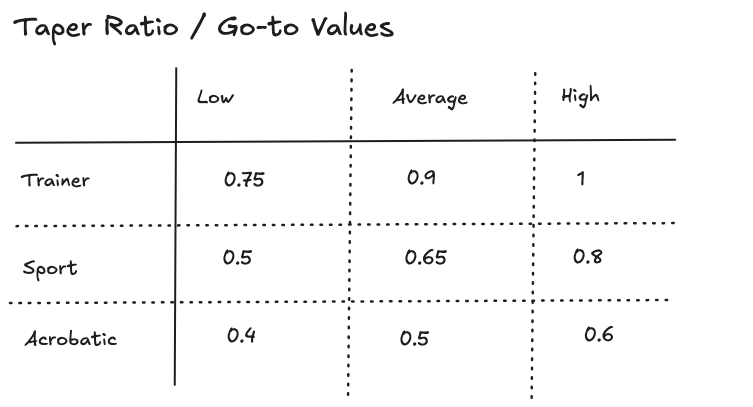
These are not targets. They define mission-consistent ranges.
A Trainer favors moderate or minimal taper to maintain forgiving stall progression. A Sport airplane balances lift efficiency with controllability. An Acrobatic design may accept stronger taper to reduce tip mass and emphasize roll response, provided stall control is handled deliberately.
Gliders are acknowledged as a distinct aerodynamic family. High-efficiency sailplanes often combine very high aspect ratios with moderate to strong taper, typically 0.3–0.7. Because these wings are optimized for glide performance rather than balanced maneuverability, they fall outside the focus of this method.
Outside these ranges, the wing may contradict its mission, either by becoming unnecessarily demanding or structurally inefficient.
Within these ranges, lift distribution remains predictable and controllable.
Taper interacts with aspect ratio, wing loading, and airfoil choice. At this stage, scale and envelope are already defined. Taper refines how lift is distributed within those limits.
What taper ratio sets, and what remains open
Once taper ratio is chosen, lift distribution along the span, tip and root chord proportions, and local aerodynamic sensitivity are largely set by this decision.
At the same time, important refinements remain open. The angle of the wing relative to airflow, the sweep of its edges, and detailed airfoil selection still shape how the wing behaves in flight.
Aspect ratio defines how far the surface stretches.
Taper ratio defines how it narrows within that span.
How that surface is oriented relative to the airflow remains open.
RC Plane Designer evolves as chapters are refined and connected.
The project began as a personal notebook used while designing scratch-built RC airplanes.
If you are learning from it or building with it, your feedback helps shape what comes next.
Follow the project or get in touch.