How the wing is oriented relative to the airflow
Span and chord distribution are defined. What remains open is orientation. Sweep determines how the wing meets the airflow.
Two wings can share the same wing area, span, and loading, yet behave differently because their orientation is different.
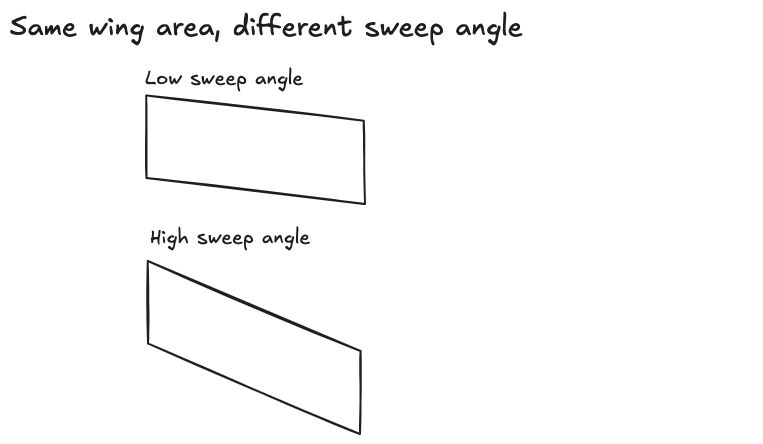
What sweep angle really changes
Sweep alters how lift develops along the span.
A straight wing generates lift perpendicular to the leading edge. Airflow remains mostly chordwise. Stall progression is typically predictable at RC Reynolds numbers.
As sweep increases, airflow gains a spanwise component. Lift distribution shifts. Stall behavior becomes more sensitive to tip geometry, taper, and washout.
Moderate sweep can improve yaw stability, assist longitudinal balance, and refine stall progression when paired with appropriate taper.
Stronger sweep reduces effective lift at low speed, raises stall speed, and increases induced drag at typical RC model scale.
In RC airplane, sweep is rarely about high-speed drag reduction. It primarily influences stability, stall progression, and geometric balance.
Sweep as a geometric relation
Sweep angle is measured between the quarter-chord line and the longitudinal axis.
Sweep angle (Λ) = Angle between quarter-chord line and airplane longitudinal axisA straight wing has 0° sweep.
Positive sweep moves the tips rearward.
Increasing sweep reduces the airflow component perpendicular to the wing leading edge. This reduces the effective aspect ratio and the lift generated for a given span.
Sweep describes orientation within the envelope already defined.
Designing inside mission-consistent ranges
Like span and taper, sweep operates inside mission-dependent limits.
It must support stall behavior, longitudinal balance, and overall coherence.
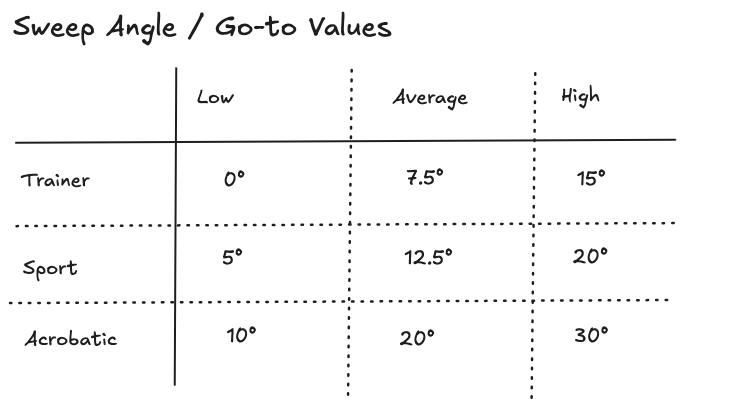
These define mission-consistent ranges, not targets.
A Trainer favors minimal sweep to preserve lift efficiency and forgiving stall progression.
A Sport airplane may use moderate sweep to balance stability and responsiveness.
An Acrobatic design may accept stronger sweep to compact geometry and refine yaw behavior, provided stall characteristics are managed deliberately.
Outside these limits, sweep can introduce instability or drag penalties that contradict the mission.
Sweep refinement happens within those ranges.
Sweep interacts with taper, aspect ratio, and loading. At this stage, the structural envelope is fixed. Sweep adjusts orientation within it.
What sweep ratio sets, and what remains open
Once sweep is chosen, lift orientation relative to the fuselage is defined. Yaw behavior and longitudinal balance are directly influenced.
Sweep fine-tunes balance without redefining the envelope.
With sweep established, the wing’s planform geometry is largely determined.
When span, surface, taper, and sweep are fixed, chord lengths can be computed. Use the Wing Chords Calculator to generate root and tip chords.
The next step moves from planform geometry to airfoil behavior and incidence.
RC Plane Designer evolves as chapters are refined and connected.
The project began as a personal notebook used while designing scratch-built RC airplanes.
If you are learning from it or building with it, your feedback helps shape what comes next.
Follow the project or get in touch.