The reference everything else aligns to
Once wing area and wing loading are defined, the wing is no longer just area. It becomes geometry that must be positioned and described consistently.
At that point, a simple problem appears. The wing does not have a single chord length.
On a rectangular wing, the chord is constant along the span. But most wings are not rectangular. Their chord changes, sometimes significantly. Without a common reference, longitudinal positions become inconsistent and proportions become difficult to compare across designs.
The Mean Aerodynamic Chord solves that problem.
It provides a single reference length that represents the wing as a single reference, not by averaging geometry, but by capturing the effective lift distribution in a usable geometric form.
The MAC can be understood as the chord of an imaginary rectangular wing that would produce the same aerodynamic effect as the real one. It is not a perfect physical description of lift distribution. It is a practical abstraction. For RC design, it is precise enough to serve as a practical reference..
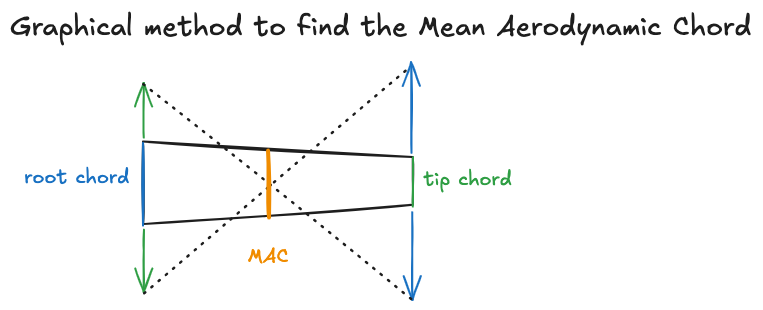
Once defined, it becomes the reference used to express longitudinal relationships throughout the airplane.
When geometry is expressed relative to the MAC, proportions remain meaningful even if the wing is resized or reshaped. Lever arms and stability margins can be expressed in relative terms rather than absolute millimeters, keeping comparisons consistent across airplane sizes.
MAC does not determine stability. It does not decide whether the airplane will fly well. It does not replace tail sizing, airfoil choice, or balance decisions. It defines the coordinate system within which those decisions will later be evaluated.
It provides the ruler, not the answer.
MAC as a geometric relation
The calculation of the MAC relies on a geometric abstraction accurate enough for RC design and appropriate for decision-making. It does not attempt to model the full lift distribution. It captures the dominant geometric effect in a repeatable form suitable for design decisions.
For a trapezoidal wing, the MAC depends on the root chord, the tip chord, and the taper ratio.
Taper ratio (λ) = Tip chord / Root chord
MAC = (2/3) × Root chord × (1 + λ + λ²) / (1 + λ)
In the special case of a rectangular wing, where root and tip chords are equal, the MAC is simply equal to that chord.
No additional calculation is required.
This formulation is simple and sufficient for the wings addressed in this book. As long as planform proportions remain typical, the MAC remains a stable and trustworthy reference.
What MAC sets, and what remains open
Defining the MAC does not lock the design.
The wing can still be refined. Proportions can still evolve. Geometry can still be refined.
What changes is that every longitudinal dimension now has a clear meaning and can be compared consistently.
With a stable reference in place, the next decision concerns how wing area is distributed along the span.
RC Plane Designer evolves as chapters are refined and connected.
The project began as a personal notebook used while designing scratch-built RC airplanes.
If you are learning from it or building with it, your feedback helps shape what comes next.
Follow the project or get in touch.