How wing area is stretched along the span
Wing area is defined. Wing loading is coherent. The mean aerodynamic chord provides a stable reference.
What remains open is how that surface is distributed along the span.
Aspect ratio describes that distribution.
It does not add area or change loading. It determines how far the same surface is spread.
Two wings can share the same area and loading, yet behave differently because that area is distributed differently.
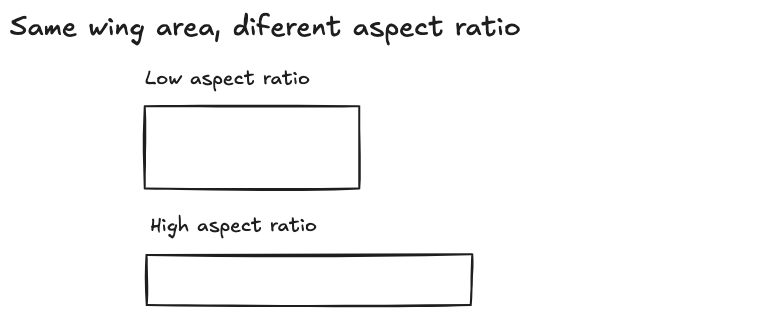
A low aspect ratio concentrates area closer to the root, resulting in a shorter, wider wing. A high aspect ratio spreads the same area over a longer span, producing a narrower, more elongated wing. This relationship influences efficiency, roll behavior, structural demand, and handling margins.
What aspect ratio really changes
Aspect ratio is best understood as a distribution choice with consequences.
As aspect ratio increases, the wing becomes more efficient. Induced drag decreases, glide improves, and lift is generated more efficiently. This favors smooth flight and sustained maneuvers. At the same time, the wing becomes longer and more flexible. Roll response slows, structural loads increase, and stiffness becomes harder to maintain.
As aspect ratio decreases, the opposite happens. The wing becomes more compact and stiffer. Roll response improves, structural simplicity increases, and the airplane feels more agile. But induced drag rises, low-speed efficiency drops, and the wing must work harder to sustain flight.
Pushing aspect ratio toward either extreme serves a specific design intent. It also reduces margins elsewhere. Aspect ratio never acts alone. Its effects are coupled with wing loading, span limits, and structural choices.
Aspect ratio as a geometric relation
Aspect ratio does not determine the design. It describes it.
That is why it can be expressed in two equivalent ways, depending on what is already known.
Aspect Ratio = Wingspan² / Wing Area
This form highlights the relationship between span and surface. For a given area, increasing span increases aspect ratio.
Aspect Ratio = Wingspan / Mean Aerodynamic Chord
This second expression ties aspect ratio directly to the reference established earlier. It shows how span and chord combine to distribute area along the wing.
Neither formula dictates the choice. They make the distribution explicit and its consequences easier to compare.
Practical limits and mission-consistent ranges
In practice, aspect ratio is constrained long before fine geometry is considered. Span may be limited by transport, structure, or control considerations. Wing loading defines how much lift the wing must generate. Within those boundaries, aspect ratio can be adjusted, but never independently.
Changing aspect ratio inevitably affects other parameters as well. A longer span increases bending moments and inertia. A shorter span concentrates loads and raises induced drag. For this reason, aspect ratio is selected within mission-consistent ranges rather than optimized in isolation.
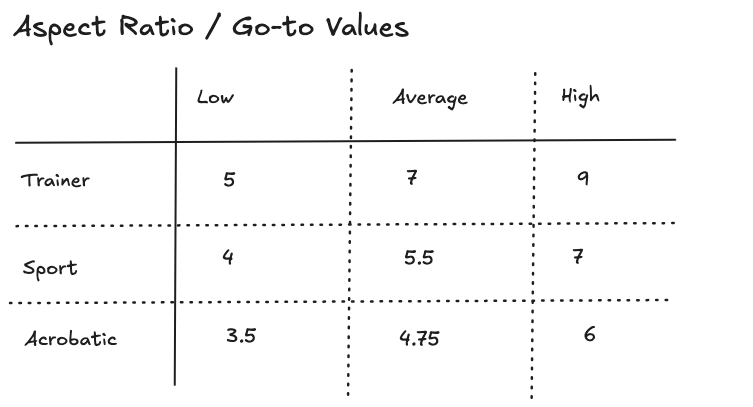
A trainer favors moderate aspect ratios that support efficiency without sacrificing tolerance. Sport designs balance span and agility. Acrobatic airplanes often accept lower aspect ratios to prioritize roll rate and structural stiffness.
Gliders are acknowledged as a distinct aerodynamic family. Thermal and performance sailplanes typically use aspect ratios around 10–25, far higher than the ranges considered in this method. Because these wings prioritize glide efficiency and induced drag reduction rather than maneuverability, gliders fall outside the scope of the present design approach.
What aspect ratio sets, and what remains open
Once aspect ratio is chosen, some characteristics are largely set. Overall efficiency, roll inertia, and structural demand are strongly influenced by it. At the same time, many refinements remain available. How chord varies along the span, how lift is concentrated near the root or tip, and how the wing behaves near stall are still open questions.
Aspect ratio defines how span is used.
How chord is distributed within that span remains open.
Span stretches the wing. Taper will shape it.
RC Plane Designer evolves as chapters are refined and connected.
The project began as a personal notebook used while designing scratch-built RC airplanes.
If you are learning from it or building with it, your feedback helps shape what comes next.
Follow the project or get in touch.