Roll control is not about producing more lift, but about producing it asymmetrically.
Until now, the wing has been designed to generate lift efficiently and predictably. But an airplane must also control how that lift is distributed between the two wings.
This is the role of the ailerons.
Located on the trailing edge of the wing, ailerons create a difference in lift between the left and right sides of the airplane. When one aileron deflects upward and the other downward, lift decreases on one wing and increases on the other. The resulting imbalance generates a rolling moment around the airplane’s longitudinal axis, allowing the airplane to bank and turn.
Two factors determine how strong this rolling effect becomes: the distance from the fuselage, which defines the lever arm, and the aerodynamic force generated by the control surface. The farther the aileron is from the airplane’s centerline, the stronger the rolling moment produced for the same change in lift.
Ailerons placed farther from the fuselage, or designed with larger surface area, produce stronger roll authority.
In practice, designers must decide where the ailerons are positioned along the wing and how large they should be.
The first design choice is therefore the aileron architecture.
Aileron Architectures
Three main architectures are commonly used: full-span, semi-span, and outboard ailerons. These architectures differ mainly in how far the control surface extends along the wing span. Each represents a different balance between roll authority, stall behavior, and wing geometry.
Regardless of the architecture, designers usually leave a small margin between the outer end of the aileron and the wingtip. The outer wing is often the first region affected as the wing approaches stall. Keeping the aileron slightly inboard helps preserve roll control near the limits of the flight envelope. Leaving this margin also improves structural behavior near the wingtip and reduces the risk of control surface flutter.
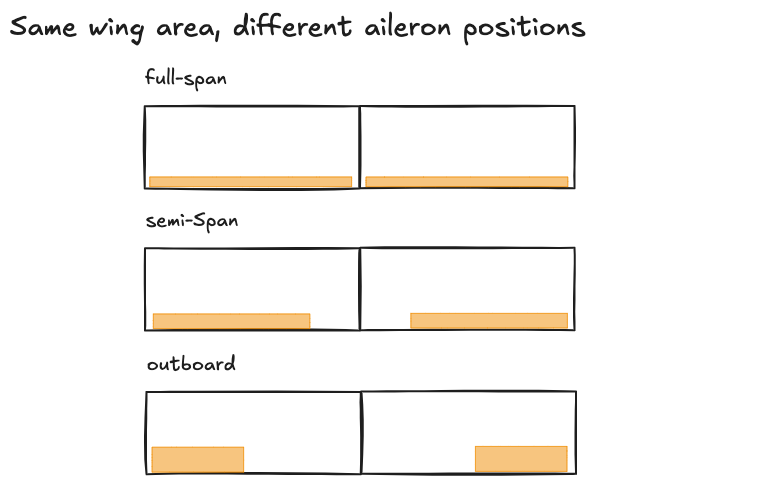
Full-Span Ailerons
Some airplanes use full-span ailerons extending along most or all of the trailing edge.
This configuration distributes roll control across the entire wing and can remain effective even when the outer wing approaches stall. It is often used on agile airplanes where strong roll response is desired.
However, this architecture introduces several trade-offs. Structural and control loads tend to increase, and the inner trailing edge can no longer be used for flaps.
Semi-Span Ailerons
Semi-span ailerons extend along a significant portion of the wing but do not cover the entire trailing edge.
By distributing control across a larger section of the wing, they provide strong and progressive roll authority while remaining compatible with many wing layouts. This configuration is common on sport and aerobatic airplanes where responsive roll control is desired.
Because the control surface is spread along the wing, aerodynamic loads are also distributed more evenly.
Outboard Ailerons
In this configuration, ailerons occupy only the outer portion of the wing.
Because they act far from the airplane’s centerline, even small lift changes produce strong rolling moments. This makes outboard ailerons effective and predictable for many airplane configurations.
Another advantage of this configuration is that the inner wing remains available for flaps.
Surface Size and Wing Interaction
Aileron effectiveness depends primarily on the control surface area relative to the wing.
In theory, this relationship can be derived from aerodynamic equations linking lift change, control surface deflection, and the moment arm along the wing. When these relationships are examined across typical airplane configurations, they consistently converge toward a simple geometric proportion: the total aileron area must represent roughly 5% or more of the wing area to provide adequate roll authority.
Rather than solving the full aerodynamic equations during preliminary design, this requirement can be expressed more directly through geometry.
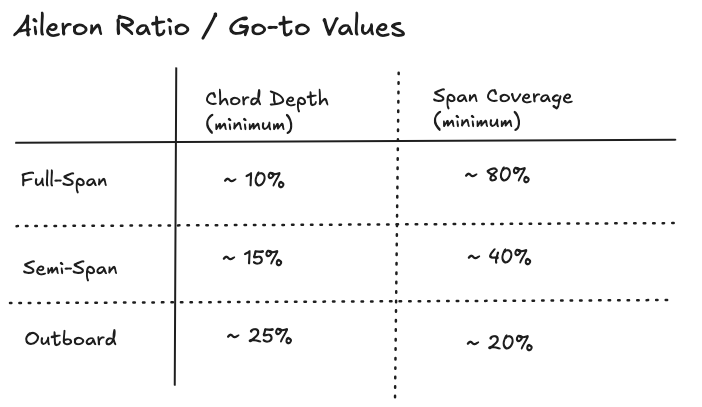
Because aileron area is the product of span and depth, designers typically define ailerons using two parameters: how much of the wing span the aileron occupies, and how deep the control surface is relative to the local wing chord.
A shorter aileron must therefore be deeper to generate sufficient aerodynamic force, while a longer aileron can remain shallower. In practice, these combinations tend to produce similar overall control surface areas relative to the wing.
Wing geometry also influences where ailerons should be placed. Rectangular or moderately tapered wings usually stall first near the root, leaving the outer wing flying longer. This allows outboard ailerons near the tip to remain effective even as the airplane approaches stall.
Highly tapered or swept wings behave differently. The reduced chord near the tip increases the risk of early tip stall. In these cases, designers often extend the ailerons further inboard or increase their span to maintain roll control across the usable flight envelope.
For practical design, these geometric relationships can be translated into typical proportions of span coverage and chord depth, which provide reliable roll authority for most airplane configurations.
Completing the Wing
At this point, the aerodynamic behavior of the wing is fully defined.
Its planform geometry determines how lift is distributed along the span.
Its airfoil and thickness determine how lift is generated.
Its incidence defines how the wing naturally produces lift in normal flight.
Its ailerons allow the pilot to control lift and command roll.
The wing now provides both lift and control.
The next step is the fuselage, which connects the major components of the airplane and defines the airplane’s overall proportions.
RC Plane Designer evolves as chapters are refined and connected.
The project began as a personal notebook used while designing scratch-built RC airplanes.
If you are learning from it or building with it, your feedback helps shape what comes next.
Follow the project or get in touch.