Primary driver of flight characteristics
The wing is the first structural commitment of the design.
More than any other part of the airplane, the wing determines what is possible.
The fuselage adapts to it, the tail corrects it, and balance validates it.
Flight begins with lift. Before there is balance, control, or refinement, there must be a surface capable of carrying the airplane through the air in a predictable way. It is what makes flight possible.
This chapter is not about exploring every possible wing. It is about defining one that makes the rest of the airplane coherent.
More than any other part of the airplane, the wing defines what is possible. Its size, position, and proportions shape how lift is generated, how stall appears, how roll develops, and how forgiving the airplane feels when things are not perfectly aligned. Decisions made here propagate everywhere else. The fuselage adapts to the wing, the tail corrects what the wing creates, and balance validates whether those choices work together.
Very few decisions can compensate for a wing that does not match the mission.
The wing defines what the airplane can become.
The wing as a system of decisions
It is tempting to think of the wing as a shape to draw: span, chord, outline, airfoil.
In practice, the wing is a system of linked decisions, where geometry, loading, and distribution interact continuously.
Every parameter introduced in this chapter ultimately describes the same thing: how the wing area is positioned, sized, and distributed in space.
Changing one parameter rarely affects only one behavior; it shifts the balance of the airplane as a whole.
This is not a warning about complexity. It is the reason order matters. When decisions are made in the right sequence, the interactions become manageable, and the wing naturally aligns with the rest of the airplane. The method does not isolate parameters. It uses structure to keep them coherent.
Throughout this chapter, wing choices are never evaluated in isolation. Each one is tested against the same underlying question: which mission does this choice support?
From intent to envelope
By the time you reach this chapter, the mission is chosen and explicit. You know what the airplane is meant to do, what the pilot can actually control, and which forces cannot be negotiated. The role of the wing is to turn that intent into an envelope the airplane must live within.
This is where abstract goals become dimensions, where desired sensations turn into proportions, and where trade-offs stop being theoretical. You are no longer deciding what kind of airplane to design. You are defining the wing that makes that airplane possible.
Some sections include small execution tools that translate chosen ratios into precise, drawable dimensions. They do not replace decisions. They convert chosen ratios into geometry.
The big wing decisions come first. Numbers will support them later, not replace them.
How decisions unfold in this chapter
Wing design decisions do not all carry the same weight. Some define the scale of the airplane and are difficult to change once made. Others refine behavior within an already established envelope.
This chapter follows that order.
It begins with structural decisions that set the limits of the design: wing placement, overall size, and loading. These choices establish the space in which everything else must operate.
From there, geometry is defined, starting with reference quantities such as the mean aerodynamic chord and the way lift is distributed across the span.
Once that framework is stable, the chapter explores shaping decisions such as aspect ratio, taper, and sweep, followed by airfoil specifications and incidence. Control integration comes last, when the wing’s role is already defined and can be used deliberately by the pilot.
Each step narrows the envelope before refining the shape.
Why this chapter carries more weight
Some parts of an airplane refine behavior. The wing defines it.
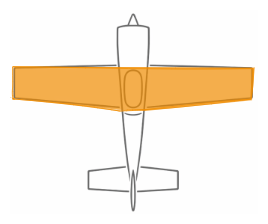
That is why this chapter is longer and more detailed than the others. Not because it is more complex, but because its decisions are foundational and harder to undo later.
The goal is not optimization. It is to arrive at a first coherent wing that fits the mission, so that the rest of the airplane has something solid to build upon.
Time spent here pays back everywhere else.
How to use this chapter
This chapter will be revisited. Some sections will clarify only after initial decisions are made. Move forward to establish direction and return when refinement requires it.
The chapter is not a checklist. It is a structure that supports real decisions.
Where we begin
The first wing decisions are not about refinement. They are about scale and placement.
Before thinking about airfoils, taper, or control surfaces, you must decide how much wing you are designing, where it sits on the airplane, and how it carries the load.
Those decisions define the envelope; everything else happens inside it.
That is where we begin.
RC Plane Designer evolves as chapters are refined and connected.
The project began as a personal notebook used while designing scratch-built RC airplanes.
If you are learning from it or building with it, your feedback helps shape what comes next.
Follow the project or get in touch.