Cycle, constraint, and coherence
With the physical baseline established, the method can now be made explicit.
This chapter defines how decisions are made, adjusted, and held, not what to choose, but how to choose and how to keep the design coherent as it evolves.
Design begins with a boundary
Before geometry is drawn or numbers are calculated, the airplane must have intent. In this method, that intent is framed inside one of three missions: Trainer, Sport, or Acrobatic.
A Trainer is stable and forgiving. It absorbs small pilot errors and builds confidence. It favors tolerance over sharpness.
A Sport airplane is balanced and progressive. It supports skill development while remaining predictable. It responds clearly, without punishing small mistakes.
An Acrobatic airplane is precise, highly responsive, and maneuverable. It delivers performance, but it does not tolerate hesitation or error. Stability margins shrink as responsiveness increases.
These missions are not presets. They define constraint boundaries. Each defines which compromises are acceptable and which qualities must dominate. Without that boundary, trade-offs remain abstract and decisions drift.
Once the mission is defined, trade-offs become concrete.
Design does not move in straight lines. It advances through cycles.
Design moves in cycles
A decision is made. It produces consequences. Those consequences reveal what still aligns with the mission, and what does not. The design responds deliberately.
For example, choosing a longer wingspan to improve low-speed behavior may increase structural weight and roll inertia. That does not mean the choice was wrong. It means the design now has something specific to respond to.
You adjust, not to chase perfection, but to realign the design with its intent.
At some point, you hold a decision steady.
Designers often refer to this as locking. But it is better understood as temporary commitment within the cycle. You stop improvising around that choice long enough to see what it enables and what it costs. Clarity appears not because the decision is final, but because the design now has something stable to react to.
Design advances through alternating choice and commitment, exploration and focus.
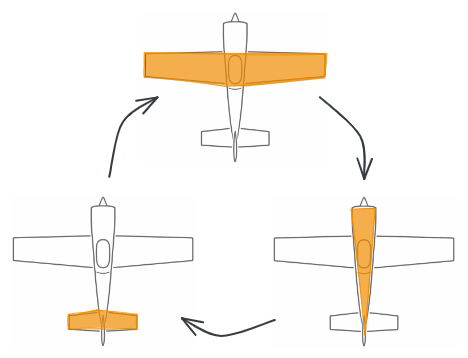
Iteration is not uncertainty. It is the natural result of working inside real constraints.
Designing inside acceptable ranges
Cycles remain productive only when decisions operate inside mission-consistent ranges.
The method does more than explain the logic behind the math. It defines acceptable value ranges for each mission.
These go-to values are not targets to optimize. They define mission-consistent ranges. Within them, adjustments remain meaningful. Outside them, the design begins to contradict its own mission.
A Trainer tolerates wider stability margins.
A Sport airplane operates in a balanced middle ground.
An Acrobatic design accepts narrower margins in exchange for sharper response.
These ranges narrow the space but clarify it.
They constrain the design space so decisions carry weight. Inside those ranges, creativity becomes productive. Refinement, adjustment, and personal preference live there.
Creativity does not happen outside constraints. It happens inside mission-consistent ranges.
Trade-offs are the proof of commitment
There are no free improvements in airplane design. A gain in stability reduces agility. A longer span increases structural demand. A lighter structure requires more precision in construction. Every advantage shifts pressure elsewhere.
Trade-offs are not flaws in the process. They are evidence that a real decision has been made.
The role of the designer is not to eliminate compromise, but to decide which compromises make sense for this airplane, inside this mission and within acceptable ranges.
Coherence over optimization
Optimization searches for isolated improvements, a better number here, a lighter part there.
Coherence asks whether major choices agree with each other and with the original intent.
An airplane where wing, fuselage, tail, and balance reflect the same mission will usually outperform one where each element was optimized independently.
Coherence is not perfection. It is alignment.
Structure makes that alignment possible. It gives decisions weight without removing creative freedom.
At this point, the mission is chosen and intent is explicit. Constraints are visible. Acceptable ranges are understood. The operating logic of the design is clear.
The cycle now demands its first structural commitment.
The decision that defines the airplane’s flight behavior.
RC Plane Designer evolves as chapters are refined and connected.
The project began as a personal notebook used while designing scratch-built RC airplanes.
If you are learning from it or building with it, your feedback helps shape what comes next.
Follow the project or get in touch.