Foundation — Alignment page
Before making design decisions, we need agreement on two things: what the pilot actually controls, and what the airplane must always obey.
This page aligns vocabulary and expectations before design decisions begin.
Control Axis — What the pilot really controls
A pilot does not directly control an airplane’s path. There is no lever for “climb,” “turn,” or “go straight.”
What the pilot commands are rotational moments around three invisible axes.
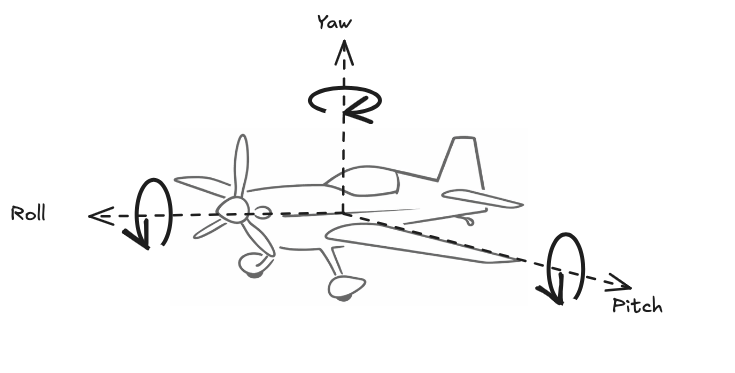
Pitch rotates the airplane around its lateral axis. It changes attitude, not altitude.
Roll rotates around the longitudinal axis. It changes bank, not trajectory.
Yaw rotates around the vertical axis. It changes orientation, not direction.
Trajectory is always indirect. You act on moments; forces respond, and the trajectory adjusts accordingly.
These axes are never isolated; acting on one influences the others.
Designing an airplane is not about adding control surfaces. It is about deciding how easily moments are created, how strongly they couple, and how forgiving the result feels in flight.
Different missions value different moment balances. A Trainer favors calm, damped responses. An Acrobatic airplane accepts sharper reactions and narrower margins of stability.
Forces of Flight — Why you can’t cheat
If axes define what the pilot can influence, forces define what cannot be negotiated.
Lift must balance weight.
Thrust must pay for drag.
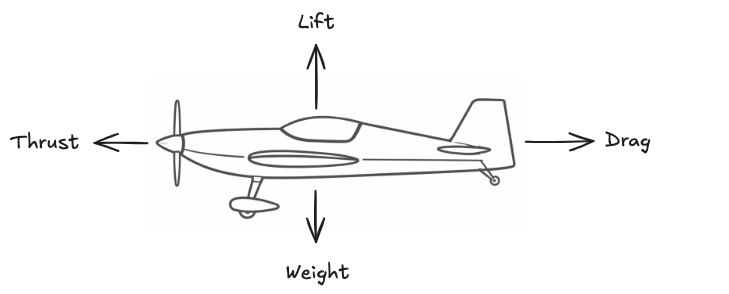
These are not variables to eliminate. They are conditions of flight.
Moments exist because forces act at distances. Geometry, proportions, and mass distribution determine how much force is required to produce rotation and how much the airplane demands in return.
In flight, every desirable quality carries a cost. More stability reduces agility. More responsiveness reduces tolerance. Greater efficiency often increases structural demand.
Forces do not explain how to fly the airplane. They explain why designs feel stable, demanding, forgiving, or exhausting.
Axes, forces, and mission
Control axes describe how the pilot acts. Forces define the limits. Together, they establish the space in which design decisions operate.
A Trainer stays comfortably inside those limits.
An Acrobatic airplane operates closer to them.
The mission does not change physics. It defines which compromises are acceptable.
What this unlocks
At this stage, deeper theory is unnecessary. You know what can be influenced and what cannot be ignored.
That is enough.
Design is not about understanding everything. It is about choosing what will matter most and committing long enough to observe the consequences.
With that alignment in place, we can move into the logic of decisions.
RC Plane Designer evolves as chapters are refined and connected.
The project began as a personal notebook used while designing scratch-built RC airplanes.
If you are learning from it or building with it, your feedback helps shape what comes next.
Follow the project or get in touch.